
The ISRAELI™ model is a framework created by Osnat Lautman that captures the defining traits of Israeli business culture. Each letter stands for one characteristic: Informal, Straightforward, Risk-taking, Ambitious, Entrepreneurial, Loud, and Improvisational. Together they explain how Israelis communicate, make decisions, and build trust, helping global professionals collaborate with Israeli colleagues, partners, and clients more effectively.
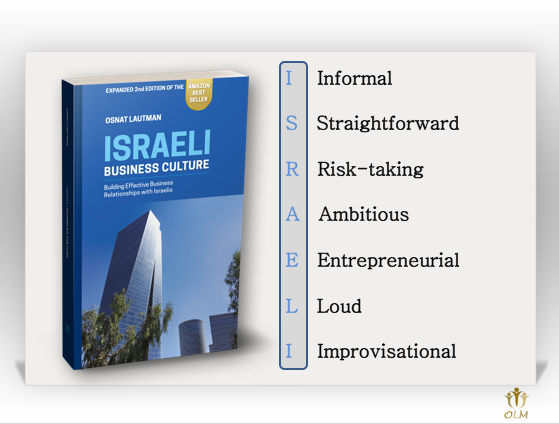
Osnat Lautman uses the word ISRAELI™ as an acronym to describe the general profile of Israeli business culture:
| I | Informal: Casual dress, first names and nicknames, and personal questions, even with senior leaders. |
| S | Straightforward: What they say is what they mean. If an Israeli thinks you are wrong, he will simply say so. |
| R | Risk-taking: Comfortable with uncertainty, asking hard questions and exploring every possibility. |
| A | Ambitious: A constant drive to advance and reach the goal. |
| E | Entrepreneurial: Risk-taking and ambition combine into an instinct to create something new. Israel is a nation of entrepreneurs. |
| L | Loud: High energy and intensity, little personal space, and no strict line between personal and business life. |
| I | Improvisational: Thinking outside the box, adapting and changing course until the goal is reached. |
The characteristics in depth
Informal. Israeli informality shows not only in casual dress but in how people interact. In a first meeting an Israeli might ask about your family, and colleagues address one another by nickname, even senior leaders. In Israel’s low power distance culture, the effect is a quick sense of closeness.
Straightforward. You rarely have to guess what an Israeli is thinking. What they say is what they mean. If they think you are mistaken, they will tell you directly, and when you ask for an opinion, you get an honest, unfiltered one.
Risk-taking, Ambitious, and Entrepreneurial. These three work as one. An entrepreneur combines the ambition to create something new with the willingness to take risks to achieve it, and Israel is a country of entrepreneurs. Israelis are comfortable asking difficult questions and exploring every possibility.
Loud. Loudness is not only about volume. It also shows in energetic conversation, forceful body language, and little personal space. In business there is little separation between personal and professional life, and work often continues into the evening from home.
Improvisational. Israeli culture rewards thinking outside the box: continually initiating, adjusting, and changing course as new challenges arise, until the goal is reached. Cultures that are used to investing heavily in planning and detail may find it challenging to accept changes that are made as needed, even after a decision has been reached.
About the research. The model is based on Osnat Lautman’s research, including interviews with hundreds of non-Israeli businesspeople who shared their experience of working with Israelis. Some of these interviews are recorded and used as illustrations in her workshops and talks.
Important to remember. The model describes general tendencies in Israeli society, not hard rules about every individual. Its value is not in precisely predicting how any one person will behave, but in offering a first roadmap that helps explain where communication gaps come from and how to build cultural sensitivity.
Frequently Asked Questions
What is the ISRAELI™ model?
A framework by Osnat Lautman that describes seven core traits of Israeli business culture: Informal, Straightforward, Risk-taking, Ambitious, Entrepreneurial, Loud, and Improvisational.
Who created the ISRAELI™ model?
Osnat Lautman, an intercultural expert and the bestselling author of Israeli Business Culture.
Is the model about stereotyping Israelis?
No. The model describes general tendencies, not hard rules about individuals. Its value is in offering a first roadmap for understanding communication gaps and building cultural sensitivity, not in predicting how any one person will behave.
Want to work more effectively with Israelis? Read the book Israeli Business Culture, or bring an ISRAELI™ workshop to your organization. It fits teams, non-Israeli employees in global companies, one on one onboarding for a new hire, and especially preparation before relocating to Israel.