A German manager named Valter was leading a Turkish team. He was professional, focused and highly task-oriented, and from his perspective, doing the job well was also a way of showing respect for his employees.
His team experienced his approach very differently. They wanted more personal connection and acknowledgement from their manager, and some felt unappreciated, even describing the experience as being treated “like robots.”
This story, “German ↔ Turkish Personal Warmth,” was contributed to my book Global Cultural Interplay by Dave Harbath, an American cross-cultural consultant and Executive Coach based in Turkey, and one of 48 consultants who shared their experiences in the book.
Once Valter understood what his team needed from him, he adapted his approach, invested more consciously in relationships and changed the way he interacted with them. His story came to mind when I recently looked again at what I call the helicopter view of cultural tendencies.
A helicopter view of the world
The positioning of 65 countries across the four TCAP™ spectrums is based on research I conducted for Global Cultural Interplay. It combines input from 48 experienced cross-cultural consultants from around the world with previous cross-cultural research and my own professional experience working with global organizations. The country positions should therefore be understood as cultural patterns that provide useful starting points for comparison, rather than fixed descriptions of the individuals within a culture.
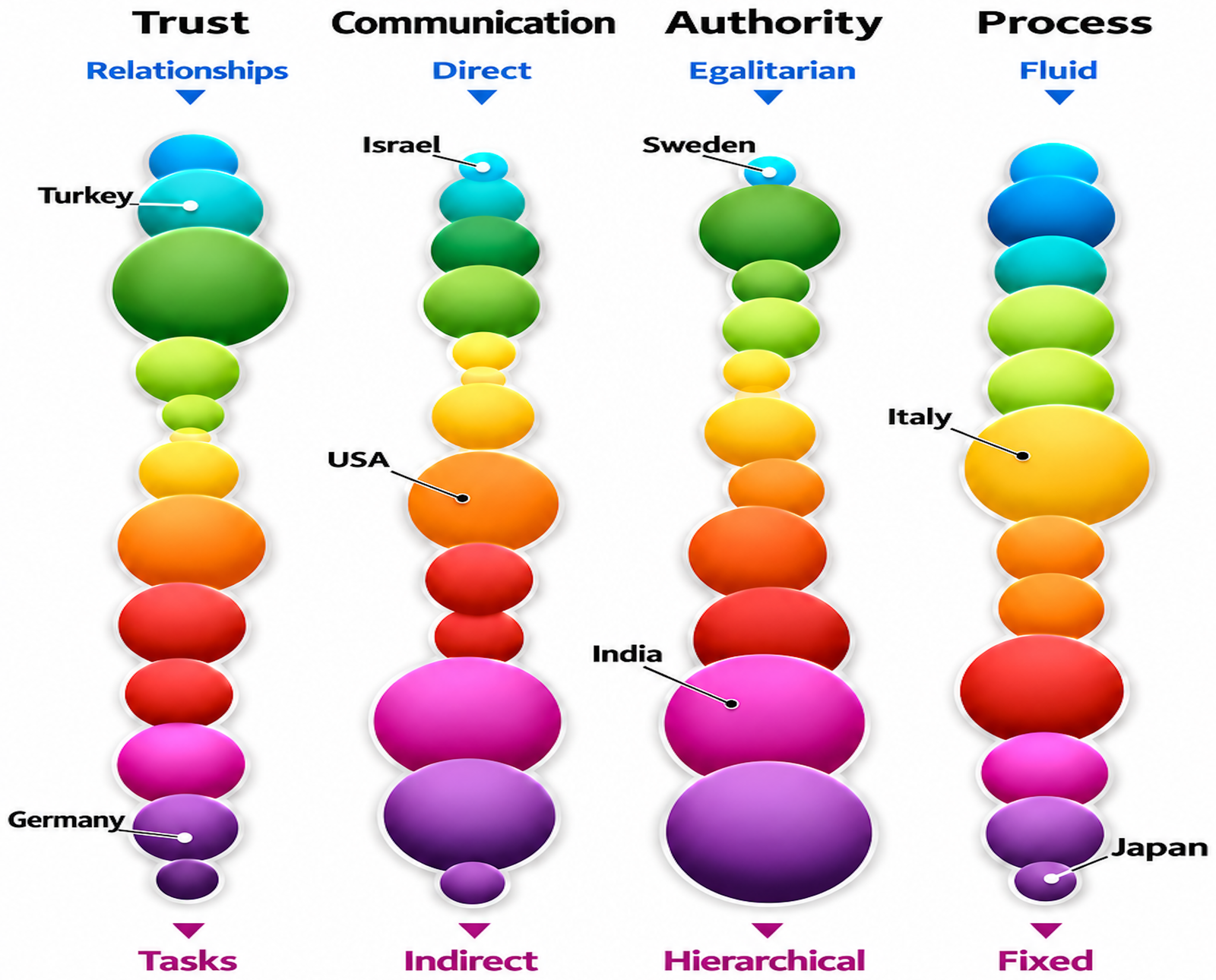
When countries are placed along the four dimensions of my TCAP™ model, Trust, Communication, Authority and Process, some interesting patterns appear. More countries lean toward relationship-based Trust than task-based Trust, while on Communication, more tend toward indirect rather than direct communication. On Authority, despite the trend in recent years toward flatter organizational structures, most countries still lean toward hierarchy to varying degrees.
Process presents a different picture. Countries are distributed much more evenly between fluid and fixed approaches, with most cultures combining elements of both rather than sitting at either extreme.
The bubbles in the chart show how many countries cluster around a similar position, so a larger bubble represents more countries rather than larger countries. Population and country size are not taken into account, and the position on a spectrum should not be interpreted as a score or as an indication that one end is better than the other.
For me, one of the most interesting questions raised by this distribution is what it can tell us about where our own tendencies sit in relation to the rest of the world.
Where are you?
If your natural tendency sits in an area where many countries are clustered, you may encounter familiar expectations more often when working globally. If it sits in an area where relatively few countries are found, you may find yourself needing to adapt more frequently.
Someone with a strongly egalitarian tendency, for example, is likely to work with many cultures where expectations around hierarchy, status and the role of the manager are different from their own. At the same time, being able to see where countries tend to sit on a spectrum only takes us so far, because our personal cultural profile does not necessarily match the general tendencies of the country we come from.
A good example is Margo Eyon, the editor of my book, who completed the Personal Cultural Assessment Tool (PCAT™) with some fairly clear expectations about what her results would be. Margo spent the first 20 years of her life in California and has lived in Israel for more than 40 years, so she was surprised to discover that on two of the four TCAP dimensions her personal tendencies were clearly American, while on the other two she fell somewhere between the American and Israeli tendencies.
Her results illustrate something that is easy to forget when we look at country maps: countries are not people. A country’s position can provide a useful starting point and help us anticipate where differences might arise, but it cannot tell us where a particular person will sit on the same spectrum.
This distinction between country tendencies and individual tendencies is one of the reasons I developed the Personal Cultural Assessment Tool (PCAT™), which maps your individual tendencies across the same four TCAP dimensions and allows you to compare your profile with two cultures of your choice.
If you are curious about where you sit, you can explore your own cultural tendencies with the PCAT™ here.
Sometimes our personal tendencies are quite close to the broader patterns associated with our culture, while at other times our personal history, experiences and environment may result in a profile that is less predictable. Margo’s experience is a good example of this, but it is also a reminder of why cultural frameworks are most useful when we treat them as a starting point for understanding rather than as an answer in themselves.
The helicopter view gives us useful context about the cultural landscape in which we work. What we do with that knowledge still depends on the particular people we meet, the differences we encounter and our willingness to adapt when the situation calls for it.